All About Sleep Efficiency: The One Number Worth Watching
 9 min read ·

Eight hours in bed does not mean eight hours of sleep. Somewhere in there is the twenty minutes it took to drift off, the stretch at 3 a.m. staring at the ceiling, and the restless hour before the alarm.
Sleep efficiency is the number that captures the difference. Of all the metrics your app shows you, it may be the one that actually deserves your attention.
Sleep, improved in real time
Get early access to better, more stable sleep.
Most sleep metrics describe a slice of your night. Deep sleep percentage, REM duration, time to fall asleep: each tells you something, and none of them tells you whether the hours you gave to sleep were actually spent sleeping.
Sleep efficiency does. It is a simple ratio, it is used clinically to guide real treatment decisions, and a sleep expert we work with considers it the single most important number in sleep. Here is what it means, what a good score looks like, and how to move it.
1. What is sleep efficiency?
Sleep efficiency is the ratio of total time asleep to total time in bed, written as a percentage. Eight hours in bed and seven hours asleep gives you an efficiency of about 88 percent. It is the cleanest measure of how much of your sleep opportunity you are actually using.
The formula is as simple as it looks: total sleep time divided by time in bed, multiplied by 100. If you get into bed at 11 p.m., get out at 7 a.m., and were genuinely asleep for six and a half of those eight hours, your sleep efficiency for the night is roughly 81 percent.
What makes it useful is that it absorbs several problems into one figure. Time spent lying awake before sleep arrives counts against it. So does every awakening in the middle of the night. So does the early-morning stretch where you are technically in bed but no longer sleeping. Any of those on their own might look minor; together they show up clearly in one percentage.
That is why sleep efficiency behaves differently from the metrics we examined in why your sleep score isn't the whole story. A sleep score is a proprietary blend from a black-box algorithm. Sleep efficiency is arithmetic, and you can compute it yourself.
2. Why sleep efficiency matters more than most metrics
Sleep efficiency is one of the few sleep metrics that clinicians act on directly. In insomnia treatment it is not just measured, it determines what happens next in the protocol.
A sleep expert we work with makes the case plainly: of everything a device can show you, sleep efficiency is the one number he would keep, and the one he considers most reliably connected to sleeping better. That is a strong claim, and it is worth being precise about what supports it.
The strongest support is clinical. Sleep efficiency is the metric that drives sleep restriction therapy, a core component of CBT-I. In standard protocols, time in bed is compressed to match how much you actually sleep, then added back gradually. The decision of whether to add time is made on efficiency: roughly, add thirty minutes when efficiency is 90 percent or above, add fifteen when it is 85 to 89, hold steady in the low 80s, and reduce when it falls below 80.
That is the practical argument for treating it as your hero metric. It is not just descriptive. It is the number that tells you what to change, which is exactly what most sleep data fails to do.
3. What is a good sleep efficiency?
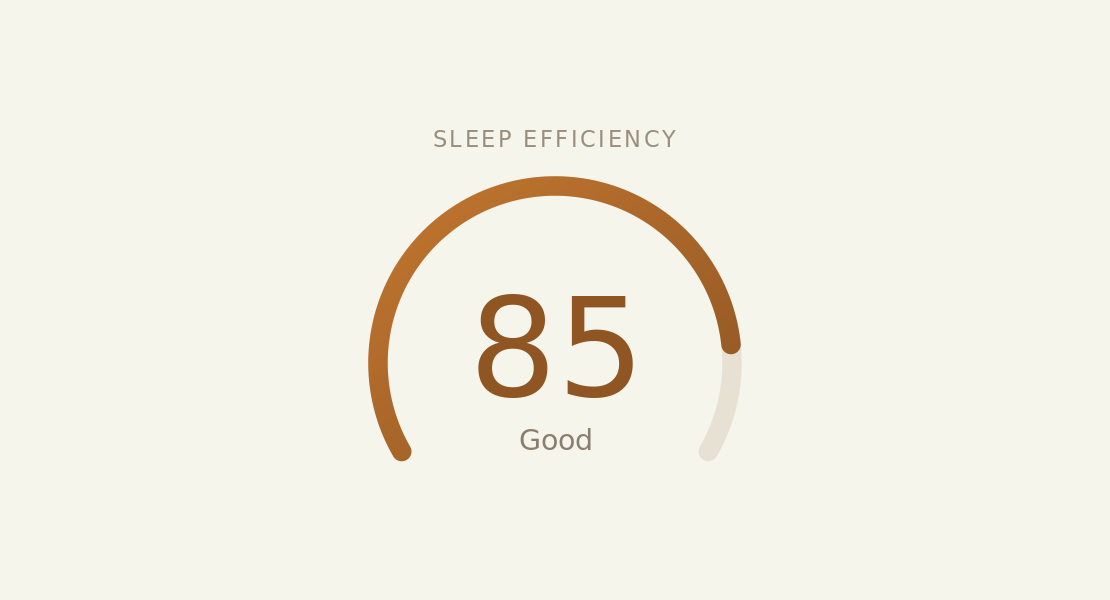
85 percent or higher is the widely used benchmark, and it is the clinical target in insomnia treatment. Between 65 and 85 percent is generally described as suboptimal, and below 65 percent as very poor.
The 85 percent figure is not arbitrary. Research classifies sleep efficiency above 85 percent as optimal, 65 to 85 percent as suboptimal, and below 65 percent as very poor, and 85 percent is the level clinicians aim for when treating insomnia.
One caveat worth holding onto: 100 percent is not the goal, and chasing it would be a mistake. Brief awakenings are a normal feature of healthy sleep, and it takes most people some minutes to fall asleep. An efficiency in the mid-to-high 80s or low 90s describes a night that is working, not a night that fell short of perfect.
There is also a subtlety in the measurement itself. Researchers have debated what the denominator should be, since "time in bed" can mean the time you lay down or the time you switched the light off. Different devices make different choices, so compare your efficiency against your own history rather than against a friend's number.
4. Consistency beats a high score
A steady 85 percent night after night does more for how you feel than an efficiency that swings between 70 and 80 percent, or one that spikes high after a poor stretch. Stability is the point, not the peak.
This is the part most people miss. Our expert's observation is that users who hold a consistent 85 percent feel better over time than users whose efficiency fluctuates between 70 and 80 percent, even when the averages are not far apart. The variability itself is the problem.
It fits what we know about sleep more broadly. Regularity has repeatedly proven to be a powerful predictor of how people actually function, which is why we argued in our guide to sleepmaxxing that a consistent schedule is the habit that makes every other habit work. Sleep efficiency behaves the same way. A stable number means your sleep system has found a rhythm it can repeat.
Practically, this changes what you look at. A single low night tells you almost nothing. A two-week trend line tells you a great deal. Watch the shape of the line, not last night's figure.
5. How to improve your sleep efficiency
Since efficiency is time asleep divided by time in bed, there are only two levers: spend less time awake in bed, or stop giving yourself more sleep opportunity than you can fill. Reducing nighttime awakenings is the most direct lever of all.
Reduce the awakenings. Every time you wake in the night, the clock keeps running while your sleep does not. Our expert points to this as the primary route to better efficiency, and arithmetically he is right: fewer and shorter awakenings raise the numerator without touching the denominator. If you wake regularly at the same hour, our piece on why you wake at 3 a.m. covers what tends to be behind it.
Match time in bed to actual sleep. Lying in bed for nine hours hoping to catch seven is efficiency's worst enemy. Compressing your sleep opportunity to something closer to your real sleep need concentrates sleep and raises the ratio. This is the engine of sleep restriction therapy, and it usually feels counterintuitive before it feels good.
Protect a consistent wake time. A fixed wake time anchors the circadian signal that determines when sleep pressure peaks, which shortens the time you spend waiting for sleep at the front of the night.
Keep the bed for sleeping. Working, scrolling, or worrying in bed teaches your brain to associate the bed with wakefulness. Getting up during a long awakening, rather than lying there frustrated, protects that association and, over time, your efficiency.
6. Where Raizz fits: efficiency as the hero metric
We treat sleep efficiency as the number worth building around, and the reason is the one above: it is the rare metric that both reflects your night and tells you what to adjust. It is a natural fit for how we see sleep as a system, since efficiency measures the whole system's output rather than one component of it.
Raizz works on efficiency from both directions. Through closed-loop vibration stimulation, the device supports more settled, consolidated sleep across the night, which targets the awakenings that pull efficiency down. Through the app's personalized CBT-I framework, it works on the behavioral side that clinicians use efficiency to steer: how much time you give yourself in bed, when you get up, and what happens on the nights that go badly.
Those two sides are the same ones we mapped in our look at smart sleep devices, the physiological and the behavioral, and sleep efficiency is where they meet on a single line of your chart. Raizz is designed to complement healthy sleep habits and clinical care rather than replace them, and if your efficiency stays persistently low, that is worth raising with a clinician.
What this means for your sleep
Sleep efficiency answers a question no other common metric quite gets to: of the time you set aside for sleep, how much did you actually use? It is simple arithmetic, it is what clinicians steer by, and unlike a proprietary score you can check the math yourself.
Hold onto three things. First, aim for 85 percent or above, while remembering that perfect is neither realistic nor the goal. Second, value consistency over peaks, because a steady 85 tends to feel better than a number that swings. Third, if you want to move it, start with the awakenings, then look honestly at how much time you are spending in bed awake.
Frequently Asked Questions
Sleep efficiency is the ratio of the total time you actually spend asleep to the total time you spend in bed, expressed as a percentage. Divide your total sleep time by your time in bed and multiply by 100. If you were in bed for eight hours and slept for seven, your sleep efficiency is about 88 percent. It captures both how long it takes you to fall asleep and how much of the night you spend awake.
Around 85 percent or higher is generally considered good, and it is the figure clinicians use as a treatment target for insomnia. Sleep efficiency between 65 and 85 percent is often described as suboptimal, and below 65 percent as very poor. Perfect efficiency is not the goal either, since brief awakenings are a normal part of a healthy night.
The most direct route is reducing the time you spend awake in bed. That means fewer and shorter awakenings during the night, and less time lying awake before sleep arrives. Matching your time in bed to how much you actually sleep, keeping a consistent wake time, and reserving the bed for sleep all help. In clinical practice, sleep efficiency guides how much time in bed is added back week by week.
More Articles You Might Like




Have questions, want to join us, or simply want to connect? We'd love to hear from you. Feel free to reach out at
hello@raizz.com